

The global small modular reactor (SMR) industry continued gaining momentum this week as hyperscale AI demand, industrial decarbonization, and energy security concerns accelerated investment and deployment activity across the U.S. and Europe. Major developments focused on industrial nuclear projects, military microreactors, and progress in advanced reactor licensing.
A key milestone came from the Dow Chemical and X-energy Seadrift, Texas project, where the U.S. Nuclear Regulatory Commission completed an important environmental review step for the proposed Xe-100 deployment. The project would install four high-temperature gas-cooled reactors (HTGRs) at Dow’s Gulf Coast industrial site to provide both electricity and high-temperature steam for petrochemical operations. The Xe-100 uses TRISO fuel and helium cooling, positioning it as one of the leading industrial decarbonization reactor platforms globally.
“Why SMRs Are Accelerating”
Global electricity demand from AI data centers is rapidly becoming one of the largest drivers of advanced nuclear investment. According to Goldman Sachs Research, global data center power demand is expected to increase more than 160% by 2030, requiring an estimated 85–90 GW of additional nuclear generation capacity worldwide.
The International Energy Agency (IEA) projects that global electricity generation dedicated to data centers will rise from approximately 460 TWh in 2024 to more than 1,000 TWh by 2030, with SMRs expected to play an increasingly important role after 2030 as hyperscalers seek reliable 24/7 base load power.
Deloitte estimates U.S. data center electricity demand could increase from 33 GW in 2024 to as much as 176 GW by 2035, with new nuclear capacity potentially supplying roughly 10% of that growth through reactor uprates, restarts, and SMR deployment.
This surge in demand is already reshaping the nuclear sector. Major technology firms, including Amazon, Google, Meta, and Microsoft, have collectively committed billions of dollars toward nuclear energy partnerships and long-term power procurement agreements tied to advanced reactors and SMRs.
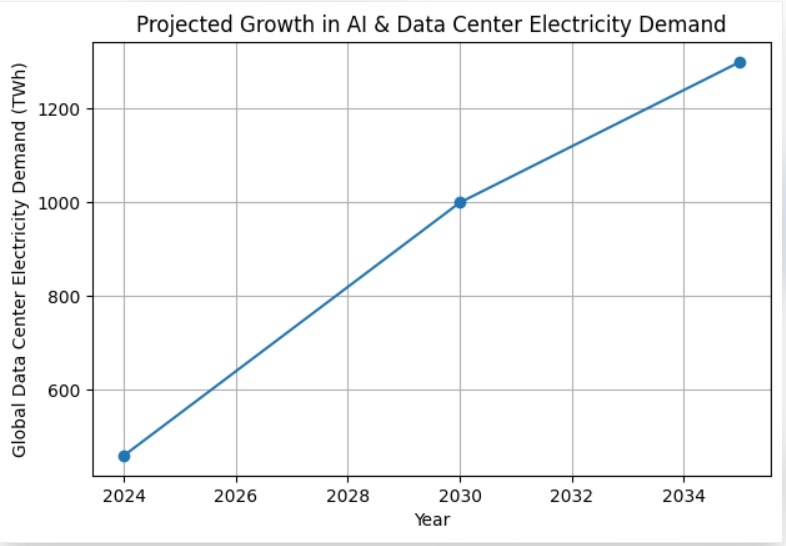
SMR’s to Power AI Data Centers
AI-driven electricity demand remains one of the strongest growth catalysts for the SMR sector. Amazon, Google, Meta, and other hyperscalers continue exploring long-term nuclear partnerships to support rapidly expanding data center infrastructure. Google remains aligned with Kairos Power, whose fluoride-salt-cooled reactor design continues to progress through demonstration and licensing stages. Meanwhile, Meta has expanded advanced nuclear engagement involving TerraPower and Oklo as part of broader AI energy procurement strategies.
Oklo continued advancing its Aurora fast reactor program, emphasizing AI-powered energy infrastructure and fuel recycling capabilities. The company’s sodium-cooled fast reactor design targets autonomous operation and flexible deployment for data centers, industrial campuses, and microgrids. TerraPower also maintained momentum on its Natrium reactor project in Wyoming, which combines sodium-cooled fast reactor technology with molten salt thermal storage to provide grid flexibility alongside baseload nuclear generation.
Traditional light-water SMR developers also remained active. NuScale continues promoting its NRC-certified VOYGR pressurized water reactor design for utility and industrial deployment opportunities. GE Hitachi Nuclear Energy’s BWRX-300 program remains among the most commercially advanced Western SMR projects, led by the Darlington deployment in Ontario, Canada, with operations targeted near the end of the decade. Holtec International also continued development planning around its SMR-300 design and the proposed Palisades SMR expansion project in Michigan.
Across Europe, advanced reactor developers continue focusing on Gen IV technologies and industrial heat applications.
Sweden’s Blykalla and France-based Newcleo are both advancing lead-cooled fast reactor programs to improve fuel efficiency and reduce nuclear waste. Dutch developer Thorizon is advancing molten salt reactor concepts focused on recycling long-lived nuclear materials, while Finland’s Steady Energy continues to gain attention for its nuclear district heating reactor program.
Energy Independence for Military Bases
Military microreactors also remain a strategic growth area. The U.S. Department of Defense continues advancing Project Pele, which focuses on transportable microreactors capable of supplying resilient power to remote and forward-operating military bases. Westinghouse’s eVinci microreactor continues drawing interest for both military and remote infrastructure applications. Malmstrom Air Force Base has emerged as a potential future deployment location as the Pentagon evaluates resilient nuclear energy systems for critical defense installations.
New Technology Creates Brighter Future
Technology diversity remains a defining feature of the current SMR market. While many near-term projects rely on conventional water-cooled reactor systems, advanced developers increasingly focus on sodium, molten salt, helium, lead, and heat-pipe cooling technologies to improve efficiency, safety, and industrial performance. High-temperature reactors are particularly attractive for chemical manufacturing, hydrogen production, and large-scale data center power demand.
Looking ahead, industry attention remains focused on licensing timelines, fuel supply chain development, AI-driven power procurement, and first-of-a-kind construction milestones. As governments and private industry continue prioritizing clean baseload power, SMRs are increasingly positioned as a central component of next-generation energy infrastructure.
The convergence of AI infrastructure growth, industrial decarbonization, and energy security concerns is rapidly transforming the SMR sector from a long-dated technology theme into an emerging infrastructure investment cycle. With utilities, industrial operators, hyperscalers, and defense agencies all pursuing advanced nuclear solutions simultaneously, analysts increasingly view SMRs as one of the most strategically important segments within the global clean energy ecosystem.
Sources: Nautilus Indexes