
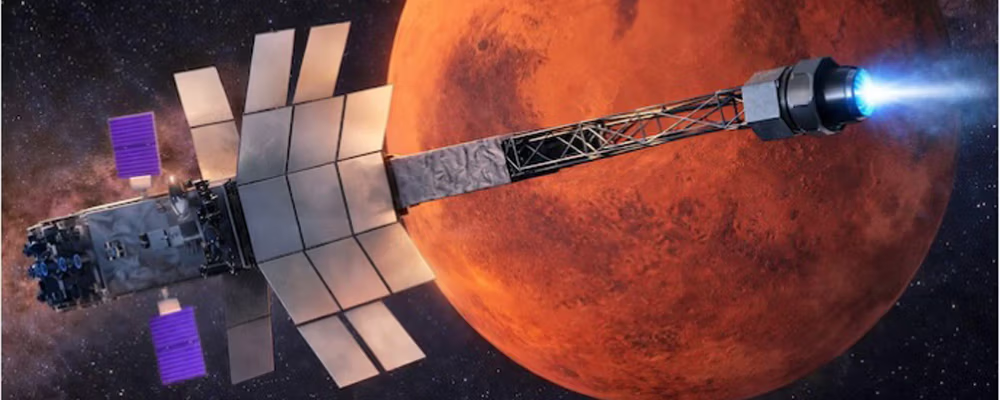
Today’s SpaceX IPO has captured investors’ attention and reignited excitement about the future of space exploration. While much of the discussion has focused on launch capabilities and commercial space opportunities, many investors are overlooking a critical component of this long-term investment theme: power
At Nautilus, we view the SpaceX IPO as a celebration of the innovation emerging from the U.S. technology ecosystem that is enabling humanity’s next era of exploration. And when discussing the future of space, it is impossible not to think about NASA.
NASA’s long-term Mars ambitions include technologies that sound like science fiction but are quickly becoming reality—from deploying fleets of helicopters on Mars to developing the first nuclear-powered interplanetary spacecraft. These initiatives align closely with the excitement surrounding today’s SpaceX IPO and highlight the broader infrastructure required to support a sustained human presence beyond Earth.
The connection between space exploration and advanced nuclear technology is becoming increasingly clear. As missions extend farther from Earth and evolve from exploration to long-term habitation, reliable power generation becomes essential. Small Modular Reactors (SMRs) and microreactors are expected to play a critical role in powering spacecraft, lunar and Martian facilities, and other deep-space infrastructure.
One of the most significant developments in this area is NASA’s proposed SR-1 Freedom mission, currently targeted for launch in December 2028.
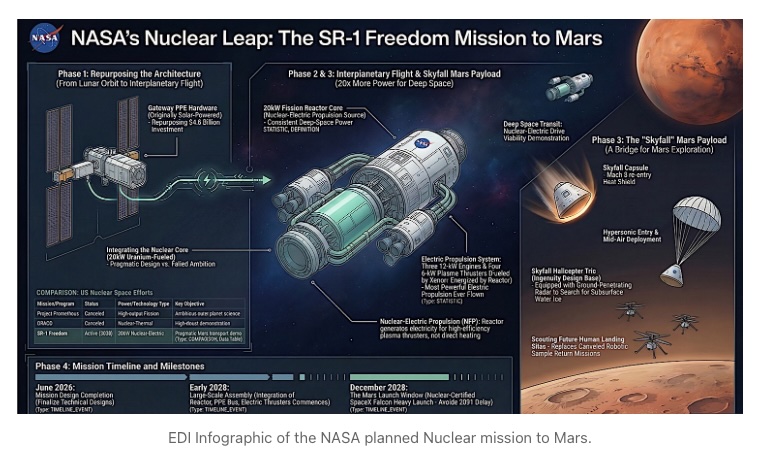
NASA officials describe SR-1 Freedom as the first planned interplanetary spacecraft to use a nuclear fission reactor as its primary power source. Developed in partnership with the U.S. Department of Energy, the mission was announced by NASA Administrator Jared Isaacman on March 24, 2026, as both a technological milestone and a statement of American leadership in space.
Deep-space missions face a fundamental challenge: solar power becomes increasingly ineffective as spacecraft travel farther from the Sun. Nuclear-powered propulsion systems offer a compelling solution because they can operate continuously and far more efficiently than traditional chemical rockets.
While the now-canceled DARPA/NASA DRACO program pursued a nuclear-thermal rocket design—which uses reactor heat to directly accelerate propellant—SR-1 Freedom is designed around a nuclear-electric propulsion (NEP) architecture.
The spacecraft’s reactor functions solely as a power plant. A 20+ kilowatt fission reactor fueled by High-Assay Low-Enriched Uranium (HALEU) and uranium dioxide generates electricity through an advanced closed-Brayton-cycle power conversion system. That electricity then powers a series of xenon ion thrusters.
Unlike chemical rockets, nuclear-electric propulsion produces relatively low thrust but delivers exceptional efficiency over long durations. Instead of relying on solar arrays to energize its xenon propellant, SR-1 will draw power directly from its onboard reactor, enabling continuous propulsion throughout much of its journey to Mars.
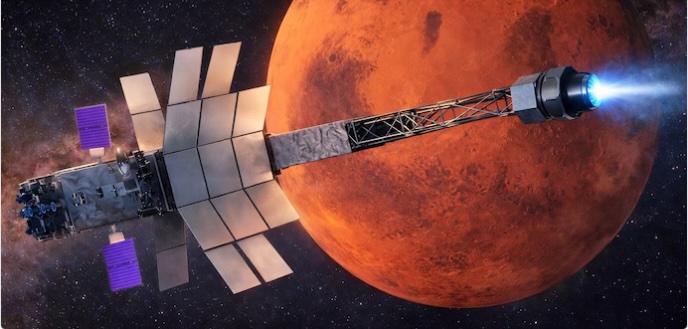
The spacecraft is expected to carry three 12-kilowatt ion engines and four 6-kilowatt thrusters, creating what would be the most powerful electric propulsion system ever flown in space (pictured above).
Beyond demonstrating nuclear propulsion, SR-1 Freedom will also carry the “Skyfall” payload—a fleet of robotic helicopters designed to operate in the Martian atmosphere. These aircraft will scout for water resources, ice deposits, and potential human landing sites, helping pave the way for future crewed missions.
NASA plans to complete major design work and begin hardware development in 2026, with spacecraft assembly and testing scheduled throughout 2028 ahead of a December launch. The reactor is expected to activate within 48 hours of launch, and the spacecraft would require approximately one year to reach Mars.
The mission also fits into a much broader policy initiative. On April 14, 2026, the White House issued National Security and Technology Memorandum-3 (NSTM-3), launching the National Initiative for American Space Nuclear Power. The directive calls for NASA to develop a mid-power space reactor of at least 100 kilowatts for deployment in the 2030s, explicitly building upon the technologies demonstrated by SR-1 Freedom.
The true significance of SR-1 Freedom extends beyond its modest power output. The mission would establish critical flight heritage for space-based nuclear systems, including the first operation of a fission reactor in deep space, the first use of HALEU fuel aboard a U.S. space mission, and the first end-to-end regulatory approval process for a nuclear-powered interplanetary spacecraft.
In many ways, SR-1 Freedom represents the opening chapter of a new industrial era in space. Just as SpaceX helped create the commercial launch economy, missions like SR-1 could lay the foundation for a commercial ecosystem built around deep-space power generation, advanced propulsion, and extraterrestrial infrastructure.
Whether SpaceX technologies ultimately play a role in SR-1 or future missions remains to be seen. However, the broader trend is becoming increasingly difficult to ignore: the future of space exploration and the future of advanced nuclear technology are becoming deeply intertwined.
For investors focused on long-term technological transformation, that intersection may prove to be one of the most important themes of the coming decades.
Sources: Nautilus Indexes, ediweekly.com