

A look at why maritime nuclear propulsion could become a meaningful growth vector for the SMR Nuclear industry and what Nautilus thematic investors should watch for.
Global shipping is under mounting pressure to decarbonize, and small modular reactors (SMRs) are emerging as one of the few technologies that can power the largest, longest-range vessels without emissions. If classification societies and regulators clear the path over the next several years, nuclear propulsion could go from zero to a multi-billion-dollar annual equipment market by the mid-2030s — and a potential multi-trillion-dollar addressable market over the following two decades.
This isn’t a forecast. It’s a scenario model — but it’s one built on real regulatory momentum, real new build pipelines, and real engineering approvals already in motion.
Why Shipping, Why Now
Three forces are converging:
- Regulatory pressure. The IMO’s decarbonization strategy targets net-zero international shipping around 2050, with 5–10% zero/near-zero-emission energy uptake required by 2030. That creates real demand pull for an alternative to marine diesel.
- Engineering credibility. ABS has already granted approval in principle for a 15,000 TEU nuclear-electric container ship using a molten-salt reactor paired with a supercritical CO₂ power system — a concrete signal that class societies are willing to engage.
- A newbuild pipeline that’s already large. The container ship orderbook alone runs to roughly 800 vessels and more than 9 million TEU. Cruise operators have close to $87 billion in newbuilds on order across ~77 ships. These pipelines give nuclear propulsion a large existing pool of decisions to influence, rather than requiring shipowners to commission entirely new vessels from scratch.
The missing piece isn’t reactor technology — it’s the harmonized IMO/IAEA safety, liability, insurance, and port-access framework that has to exist before commercial orders can be placed at scale.
The Market Size Story: 2030–2050
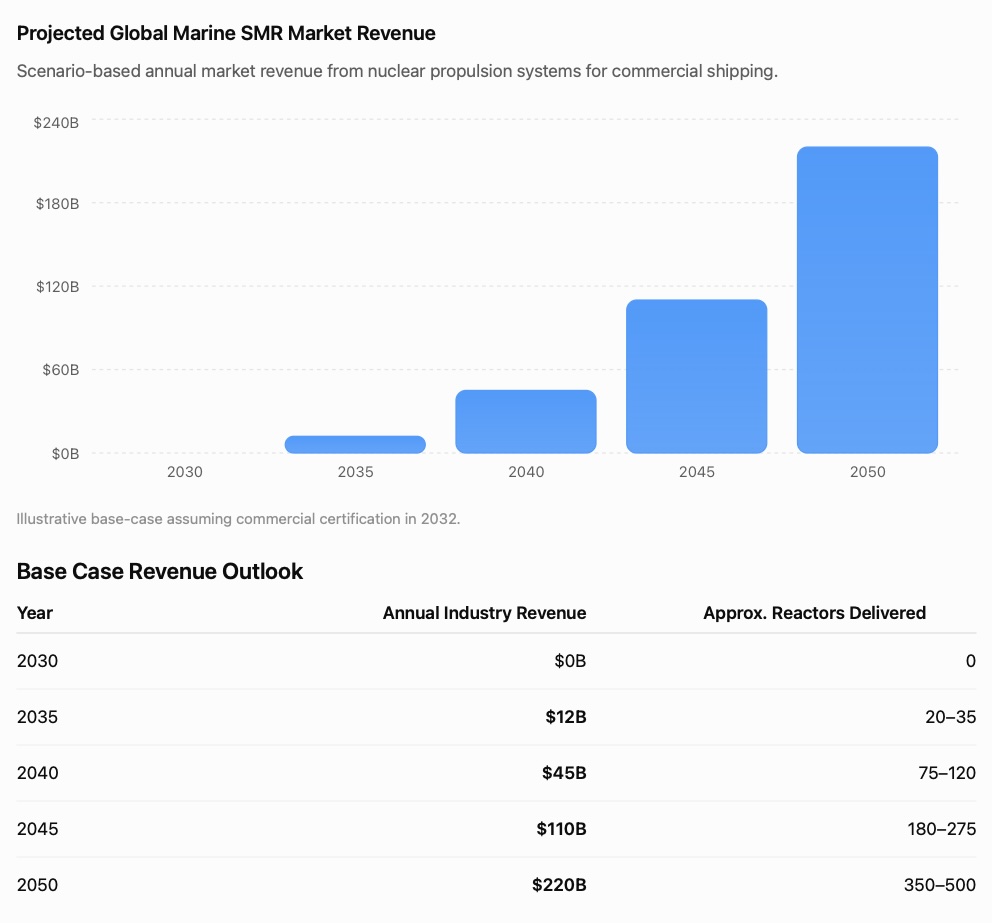
Assuming that framework materializes on a plausible timeline — regulatory groundwork substantially complete by ~2031, first commercial reactor certification around 2032, first vessel orders around 2033, first deliveries around 2035 — the base-case revenue ramp looks like this:
| Year / Annual Industry Revenue | Approx. Reactors Delivered |
| 2030~$0B | 0 |
| 2035~$12B | 20-35 |
| 2040~$45B | 75-120 |
| 2045~$110B | 180-275 |
| 2050~$220B | 350-500 |
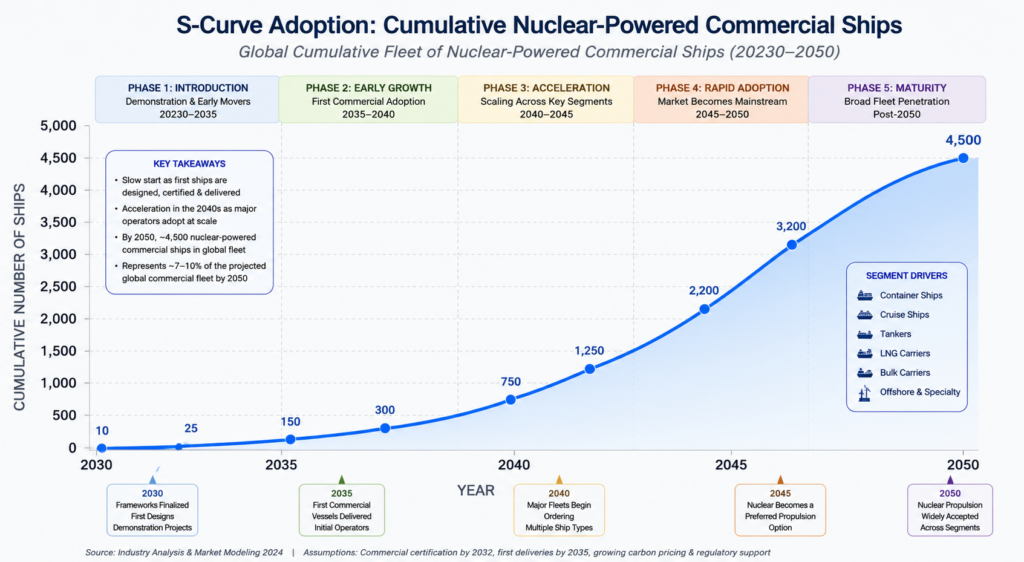
The shape of this curve is the important part, not any single number. It mirrors the adoption pattern seen in commercial aviation and LNG shipping: a slow demonstration phase, followed by a steep inflection once the first operators prove the model works and financing/insurance standardize around it.
By 2050, this scenario implies roughly 4,500 nuclear-powered commercial vessels in the global fleet — about 7–10% of the projected global commercial fleet, concentrated in container ships, cruise ships, tankers, and LNG carriers.
Long-term addressable market: with an estimated 25,000–35,000 vessels eventually viable candidates for nuclear propulsion, and $150–400 million in installed reactor system value per ship, the multi-decade equipment TAM could run to $4–8 trillion, plus $40–80 billion/year in recurring servicing, fuel management, and monitoring revenue — a services tail that, as with jet engines, may ultimately exceed original equipment revenue for SMR companies.
Where the Early Money Likely Goes
| Segment | Why it moves first | 2035 order estimate |
| Large container ships | Clearest new build pipeline; ABS approval-in-principle already granted | $5–18B |
| LNG / gas carriers | Long routes reward high power density and fuel savings | $2–10B |
| Cruise ships | High hotel-load power needs, premium assets — offset by public/port acceptance risk | $2–8B |
| Tankers / bulkers | Largest fleet by count, but slower uptake given lower power density needs | $1–8B |
| Car carriers / offshore / specialty | Niche early adopters | $1–5B |
Container ships and LNG carriers are the segments where the economics and regulatory appetite currently line up best. Cruise is strategically important — high power draw, marquee assets — but carries more public-perception and port-approval risk.
The International Maritime Organization, which is responsible for global shipping, wants the sector to reach net zero emissions by around 2050. Commercial ships majority still run on dirty bunker oil, a thick, tar-like fuel made from crude oil, and have smokestacks that spew toxic pollutants into their Air and Water. Collectively, they emit as much climate-changing CO2 as the entire country of Japan.
Who’s Positioned to Benefit
Reactor developers and marine integrators most frequently cited in this emerging space include TerraPower, Kairos Power, X-energy, BWXT, Westinghouse, Rolls-Royce SMR, GE Hitachi, Holtec, NuScale, Newcleo, Thorizon, Copenhagen Atomics, Seaborg Technologies, and marine-focused integrator Core Power. Exposure to this theme through a diversified SMR index — rather than single-name bets — is one way to participate without needing to correctly pick which reactor design or shipbuilder wins first mover status.
The Risk Section
Investors should weigh this alongside the upside:
- Regulatory timing is the single biggest swing factor. Every number above assumes IMO/IAEA frameworks and classification approval land on a specific multi-year timeline. Slippage compresses the whole curve to the right.
- This is a scenario model, not a forecast. The bull case (~$70B by 2035) and base case (~$10–30B by 2035) diverge meaningfully depending on how fast insurers, port states, and top liner operators move.Public and political acceptance of nuclear-powered vessels in commercial ports is untested at meaningful scale.
- Capital intensity is high — first-of-a-kind reactor and vessel costs typically run well above mature-technology costs, and financing structures for marine nuclear don’t yet exist in standardized form.
Bottom Line for SMRFX Index
Data Centers electricity demand dominates the early revenue streams for SMR nuclear power, but the multiple follow-on revenue streams can be meaningful, this is our research on Commercial Shipping. Nuclear shipping is not a 2030 growth story — it’s a 2035-onward story that could compound meaningfully through 2050 if the regulatory pieces fall into place roughly as outlined above. The fund’s thesis on SMR technology already captures the underlying reactor developers who would benefit most directly; commercial shipping represents a large, currently under-appreciated demand-side catalyst layered on top of grid and industrial applications.
Sources: Nautilus Indexes, dw.com
This newsletter contains forward-looking, scenario-based estimates for illustrative purposes only. These are not guarantees of future performance, and actual market development may differ materially due to regulatory, technological, and economic factors. Please consult your financial advisor before making investment decisions.